On Saturday I went for my guitar class, and was told that the results of our exams had been posted. On the notice board a sheet of names with their scores had been posted.
I scanned the names, first seeing my son, who got a distinction in his debut level drums. And then, further down, Vivek Govil, 83/100, passed with merit!
Am I relieved? Of course. Am I showing off just a bit? You betcha!
Sent from BlackBerry® on Airtel
On getting results
Download complete……..
Finally the download is complete and we have received the photographs of the Kolkata launch of Impressions. All in all, it was a splendid affair with all the ingredients of a perfect blockbuster. The show was packaged with a powerful presentation by Mr Richard Cooper who brought to the board his years of experience in training academics, HR managers and senior management in the corporate sector across the globe, as well as trainees in the UN.

Richard Cooper addressing Principals at the launch…
The evening started with Prashant welcoming the guests and introducing the speaker before handing the microphone over to Naveen who showcased Pearson’s vision for education in India.
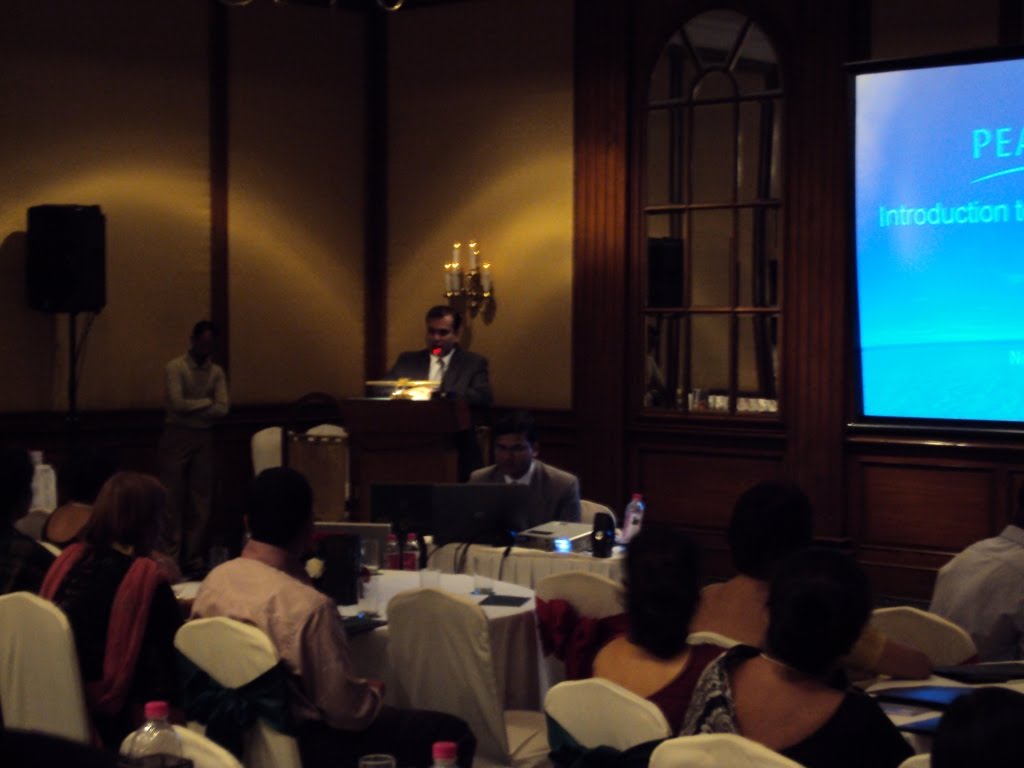
Naveen Rajlani at the podium…
Diyasree took off from there and presented some of the innovative products from Pearson, including interesting stuff like E-books and Dynamic Question Bank as well as Online Support Material for Longman Active Science & Maths. The response was heart-warming as principals of some of the city’s best schools were seen nodding their heads in appreciation of the new ideas. There was a sense of awe as teachers realised that if question papers could be generated in a matter of thirty seconds or less, then they could focus their energies on bringing creative inputs to the classroom and reinventing their teaching methods rather than being weighed down by the monotony of writing out question papers.

An august gathering…
And then it was time for the star trainer to take over. Richard conducted a delightful session in which innovative ideas were interwoven with some interesting videos and hilarious anecdotes.

During the presentation…

An attentive audience…

Interacting with the teachers…
As Richard narrated incidents from his experience of dealing with people from different countries where English is treated as a second language, an hour and thirty minutes passed in the blink of an eye. In the end, we were left with a feeling of immense satisfaction, as our guests applauded the event which had given them a truly global perspective to English Language Teaching.

Madhumita Seal (author of the Primers) with Mr Cooper…

Madhumita Seal and Supriya Bhattacharya (author of Impressions) after the launch…

A thank-you note…

And last, but not least…the team that put together the show…
On failing tests
“Still in the office?” is what I heard Vamanan say from the other side when I received his call last evening, when I was just about to shut down my computer. And then for a couple of seconds, we both laughed heartily at his joke. Once I hung up after having conversations about a certain project, I realized how truly virtual my life had become. Just the other day, a friend quipped on how long a commute it is for me to my workplace!
When people in my family heard about this arrangement called “work from home”, they couldn’t help but react sceptically. I remember how Amar had explained elaborately how difficult it is for Indians to take to this fairly new concept of working from home, and what problems one might face while in India. Let alone powercuts, and inquisitive and gossipy neighbours, disciplining the self could be a big problem. When I packed my bags and came back to Kolkata, I kept all his warnings in mind. The first few days were spent in explaining the “concept” to friends, neighbours and family members. I could see bubbles popping out of their heads—“Poor girl! She must have been fired! The market is in such a bad shape…it leaves people with no other option but to lie about what they do! What work can she possibly do while staying at home all day?!”—while they seemed to be in total agreement with me that it’s quite a novel and effective way of getting work done. I could even see my mother becoming defensive about me when inquisitive neighbours asked her about what her daughter did. She knows it’s quite a new concept in
Last week, I had to go to meet an author at his place. For the first twenty minutes, I had to explain what I am really doing out here. I realized that there have been so many books I have worked on all this while, without having met the author even once that proving myself was never an issue. The mails we sent off from the official addresses were proofs enough. They never had to allow me into their personal spaces, so things were pretty comfortable! When I rang the bell at my author’s place, I knew I would have to take these mental tests to prove I am the editor from Pearson Education, who is working on his book. The other factor that has always worked against me in such cases is the fact that I look younger than what I really am! And such elderly, learned and erudite authors often have issues trusting such seemingly young editors with their manuscripts. So I had dressed up in a sari to ensure I at least looked mature. Amar’s advice keeps echoing in my head in such situations: “Don’t start giggling!” That’s one more part of me that works against me when I have to prove myself. People who giggle too often are seldom taken seriously! So here I was, standing outside an author’s door, wearing a sari, and a very grim expression, with my hands folded in a “namaskar” pose!
“Tumi to chhelemanush he!” (You are such a kid!), my author said as he opened the door. Well, I failed my first test there. All efforts of pretension in vain! Next, maintaining my grim expression, I handed over my visiting card to him, to add some authenticity to my identity. He took it from my hand, read it carefully, and stared at me questioningly. “But this says you are from Pearson Education, Noida? What’s the deal? Where do you work from? From Kolkata or from Noida? And if from Kolkata, HOW?” So I fail my second test! Still grim, but polite, I go back to explaining all that work-from-home is about!
By the end of our meeting, he seemed quite satisfied. Before he closed the door behind me, he said, smiling, “Eto chhelemanush hoye, eto bhalo kaj korchho! Besh bhalo laglo!” (Even though you are such a kid, you are working so competently! I feel good!) So I passed. I figured one way or the other, it is not all that bad to fail a couple of tests initially to get some appreciation at the end!
On taking exams
I took my Grade 2 guitar exam today. The average age of the other examinees is about 14. Its easy to forget how stressful even a simple exam like this can be - pieces that I have practised a hundred times still come out wrong when there is an examiner poised to score me.
The last exam I took was my UK driving test, that was ten years ago, and I won't tell you when I took a test before that, because most of the readers of this blog were probably just starting school about then!
Anyway, its over and I should at least pass, so on to the next grade.
Sent from BlackBerry® on Airtel
Travels in the North East
I made a long delayed visit to the North East this week. As you may know, it is a significant contributor to our Schools business, and Rajiv Singh and his team are doing a great job of establishing Pearson as the premier school publisher in the region. I would urge many of you in support departments to visit the team, and get a better understanding of the rather unique challenges they face - from IT, to Customer Service, to HR.
Naveen and I visited Guwahati, Dimapur, Kohima and Tura on this visit. In fact I am writing this on the drive from Tura to Guwahati, while in the middle of the breathtakingly beautiful Garo Hills.
Rajiv claimed that you can open the school bag of any primary school kid in the state and you will find a Pearson book. This is logical, since we publish on behalf of the state board, but its illustrative of the difference in the scale of what we are doing here, and in many other parts of the country. Here, something like 600,000 students are learning English from a Pearson book.
Cynic that I am, I asked Rajiv to stop at a small government school we passed - three classrooms, one teacher. Now we have photographic evidence of the truth of his statement.

Vivek Govil
The Joy of Giving
What do you do when you have over a lakh books in the warehouse and space is at a premium? You can pulp them; and at the pitiful, peanut-like sum of 8 rupees a kilo, you might stand to make a few thousand rupees. Or you can give them away, for nothing, and the smiles of a few young readers might not do much for your bank balance, but it does give you an awfully good feeling. If you like feeling warm and mushy inside, of course.
In June 2008, Pearson Education, India, sent a few truckloads of books to Varanasi. It was the culminating step of many meetings and discussions and a lot of hard work on the part of some people. And it was the first step towards literacy for hundreds of kids who had rarely had the chance to touch, let alone own, new and unused books.
Some of these books were distributed among schools funded by a programme called World Literacy of Cananda [WLC]. Some of the books went to a mobile library, a rural library and a community library supported by Rotary Club International. One lakh sixty thousand books were distributed among forty schools. And of all the pictures that I saw from that episode, I really liked this one below. The sight of three kids on a bench, sitting and reading very earnestly tells you nothing, until you put it in context. And the context here is a centre dedicated to kids suffering from mental or physical disabilities.

It’s just a drop in the ocean. Giving out a few lakh books, in a country where millions of kids don’t get a fair chance at education, is just one step on the long road to total literacy.
This year, Pearson Education is reaching out to kids with a donation of over 3 lakh books to the Bakul Library Foundation. The Bakul Foundation has big plans, which include setting up community libraries for slum kids and organising mobile libraries to reach out to rural areas. At the same time, they have some valid concerns. The biggest challenge, according to Sujit Mahapatro from Bakul, will be to ensure that these books actually benefit the children who receive them. To this end, they are planning to mobilise volunteers to engage the children’s interest in reading books in English. And the first step of this initiative was taken on 30 September in Bhubaneswar when internationally-acclaimed actor and director, Nandita Das announced the book giving as part of the celebrations of the Joy of Giving Week in India.
Now, in our country, we have three ruling passions. There’s the Great Indian Reality Show, otherwise known as elections; the Great Indian Sport, namely cricket; and the Greatest Indian obsession—movies. So, if there’s an actress in the room, all attention is likely to be focused on her. Or so one would suppose. But take a look at this photo…
 On the right, there’s Ms Das. And beside her, a kid engrossed in a book, oblivious to the star and the clicking cameras. Now that’s something you don’t see everyday! But the event in question wasn’t a run-of-the-mill show either. As the children (and the adults present) listened enthralled, Ms Das enacted a Gujarati folk tale. After giving away some of the books donated by Pearson to the students from the Madhurmayee School for Children of Convicts, she also spoke to the media on the importance of giving as a part of our social responsibility.


Social responsibility…corporate responsibility…these are big words. At the end of the day, the smile on a kid’s face says it all.

Post script 1: In case you were wondering who the nameless faces behind the donation were, here’s the list of acknowledgements. The donation was made possible by Vivek Govil and Dipankar Bose (the latter ensured that the entire process went off without a hitch). Naveen Rajlani, Prashant Rathore and the Orissa school sales team stepped in on the day of the event to take care of some last-minute emergencies.
Post script 2: And here’s what the print media had to say about the event:
The Indian Express
The Hindu
The Times of India
Nagging Nostalgia
It's probably my umpteenth attempt at writing something since a very long time. I had heard a friend say once that skills of an editor and those of an author are supposedly inversely proportional; or rather "an editor is a failed author". (Later he had added as an afterthought, "But well, we all know that it's not true!") Amidst a crowd of thoughts that I keep collecting and filtering every day, this was something that stayed on with me. Every time I would be confronted by a blank screen, or a blank sheet of paper, being true to the editor that I am, I would almost begin to panic. What am I going to write? What is it that I really want to write? And primarily, why would I write? The moment I would reach the "why" of anything, all reasons would just drown under the weight of the "why". I remember I used to play this game with a friend of mine, back in school. Every time we would sense the pre-exam panic attack, we would keep repeating the "why"s till the answers trickled down to nonsensical nothingness, diluting all sense of nervousness. But on the flip side, as we grew up, this made us realize how utterly meaningless everything is at the end of the day.and we swore by the Keynesian philosophy: "In the long run, we are all dead". And therefore, I justify my extreme unease about putting anything down in words.
However, we got to see the short run as well. In the constant tussle between the thoughts collected and the "why"s, sometimes the latter gives in. Now feels like such a moment. It's 1 October 2009! I begin one more phase of my working life: when I officially begin working from home. As I look back, I see that all my beginnings have been on the first day of a particular month (I began working as an intern on 1 July 2007, I began working as a full-time employee on 1 January 2008). That makes someone like me very happy, in a juvenile sort of way. I like having even numbers when it comes to numbered lists (so I accordingly manipulate points in a list, if I make one), I like round figures while paying bills, or fares (and that often means paying more than the actual fare, since anyone else would not accept less than the actual amount just to respect my eccentricity)! If I have to follow clock time, and begin work, I don't like to begin at 9.42s or 9.58s. It should either be 9.30s or 9.40s or 9.45s or 10.00s, and so on. So I have these minutes of wait.
Anyway, to come back to what I intended to write at the very beginning: I hardly ever realized I enjoyed working for Pearson Education so much till I actually left it all behind. Back at home, here in Kolkata. Every thing seems peaceful and nice, and even luxurious to a certain extent, when I compare these days with the ones I spent alone at my rented room in Patparganj (with my screaming landlord and landlady as my neighbours) after work. I don't know if it is a clear case of the grass being greener on the other side, and I had never thought I would ever be saying this, but now I truly miss everything that came with working for Pearson Education in Delhi and, later, Noida. And just like everything remote assumes a hue of nostalgia, even the puddle-strewn, cratered lanes of Madhuvihar, and the lonely rickshaw rides through the dark lanes of I.P. Extension seem so pretty now. I definitely miss the office, and the view from the seventh-floor huge glass windows that overlook the fields, the cricket players, the grazing buffalos, the roads beyond the fields, and the sunsets across the distant skyline defined by gradually emerging sky scrapers. Just the other day, I was telling a friend how taking breaks while working at home would no more mean coffee breaks at Bunker. Needless to mention the rather (in)famous TT breaks! And of course, of all the things I miss, I miss my friends and colleagues the most. How often now, without even realizing, I keep browsing through all the photographs of the two NSMs I have been able to attend! By now, everyone at home has been well familiarized with the people and their names. Even my three-year-old nephew has learnt to pronounce "Yajnaseni" (the way it is supposed to be pronounced) almost flawlessly! And it surprises me not without reason, since he still mispronounces my name as "Kusanya"!
blog post
Their Story, Not Our Glory
They say, ‘Cricket is a great leveller. It creates deities out of mortals and demons out of gods’. (I hope) Most of you may nod in agreement that our cricket commentators define the glories of this great sport in such majestic terms, invariably, when they have nothing else to observe or state.
Much to your relief/disappointment this post is not about cricket or anything remotely connected to it because I have been warned that it’s not a matter to be trifled with. However, without questioning the validity of this claim, I would like to state that cricket is certainly not the sole ‘leveller’ in this world. Among a number of other things, the one ‘leveller’ that I firmly believe in is the writing space. It does, indeed, stimulate self-expression in various degrees and forms, without taking hierarchies into account.
Hence, I regard the Pearson blog in high esteem and revere the scope it offers for debate, discussion, imagination, petulance and aggression. At the same time, I am surprised by the remarkable conservatism we display while dealing with this space. We tepidly tread the proverbial ‘middle path’ when faced with issues, which are deliciously contentious (well, you can think of at least three, without squinting...). In case you are suspecting that this piece of writing may turn out to be a treatise on the ‘act’ of writing and its functionalities, let me put your fears to rest. I would not dare to attempt or embark on such a grand exercise.
Rather, I would merely utilise this space and the medium to present certain facts and views regarding a matter which largely defines the ethical order of the publishing world and deserves more than a casual reference. The matter that I am referring to is ‘intellectual proprietorship’ and its purview, as well as our own perspective on it.
The basic standards of protection of literary and artistic works were put forth by the Berne Convention for the Protection of Literary and Artistic Works in 1886 in
Under the Berne Convention, all works (except photographic and cinematographic works) are protected by copyright for at least fifty years after the author’s death.
As the Berne Convention defined certain uniform standards for the acknowledgement and recognition of the ownership of intellectual works, a clear and definite notion of ‘copyright’ emerged. As we understand it now, it is the ‘legal, exclusive right of the author of a creative work to control the copying of that work’.
Therefore, while dealing with intellectual property, it is important for us to be aware of certain nuances of copyright.
Following the Berne Convention, all works are copyrighted as soon as they are written, and no formal notice or declaration is required.
We should be very careful while dealing with material posted on the Internet. Internet postings are not in the public domain (unless explicitly stated) and hence, copying or adaptation or replication at one’s own discretion is not permitted.
While using someone else’s work, one should be conscious of the principle of ‘fair use’. ‘Fair use’ in itself is a complex, to some extent vague and controversial idea. To make matters simple, every time we get into the act of reproducing someone else’s work or a portion of his/her work, we need to be honest about the purpose of the act. ‘Will it accomplish commercial gain and profit or will it benefit the society and help to spread awareness about a social issue without fetching me any financial gains?’ Your answer will establish your motive.
Even adapting a concept or an idea from someone else’s work and appropriating it in one’s own words is an act of violation of copyright.
Dear reader,
By now you must be writhing in your seat or gasping for breath and cursing the moment when you started reading this rambling post, may be, in a light vein. My apologies!
I admit, that this piece of writing does not qualify as humorous or entertaining, neither does it generate controversy or debate.
It merely touches upon a few facts regarding a matter, which affects us in many ways every day, and often leaves us very confused. With greater access to information, we find a vast repertoire of artistic works waiting to be explored. In our zeal to procure and utilise all that we can get our hands on, we are sometimes careless, at times irresponsible. Especially, with the Internet offering easy transaction of intellectual property, we tend to assume that they have been created to facilitate our needs. It’s indeed very tempting to take the easy way out and feign ignorance while using someone else’s work to suit our requirements. This is tantamount to theft and the sooner we realise the criminal nature of the act, the better for us and our trade.
So it is of utmost importance that we exercise fair play, sensitivity as well as conscientiousness by educating ourselves about the scope of intellectual copyright and examining the source of any material that reaches us before publishing it. It may be a little tedious, even frustrating but surely, it’s worth the effort.
As I conclude, I feel the need to defend this disorderly piece of writing, which apparently flits from one idea to another. My initial reference to cricket is not completely misplaced in the context of the subject that I have pursued so far. So let me flash my ‘writer’s license’ to draw an insipid analogy between the two. Yes, you must have guessed it…and no matter how tame it sounds, you can’t deny that it is true. If cricket is revered as the ‘gentleman’s game’, our trade too is founded upon the same principles of fairness and integrity. And we are the incorruptible white knights in charge of protecting its honour!
Soumitri
The Joys of Reply All
Observation número uno: In a hierarchy-driven organisation, not only will people hit Reply All, they will copy their immediate supervisor into a test mail.
Observation number two (I ran out of Spanish at this point): In a paranoid world, where data-security and data-privacy are fairly alien concepts, people will hit Reply All, copy their immediate supervisors and cc their personal mail id.
Fascinating doesn’t quite cover it.
Delirium
Reply vs Reply All
It’s fascinating how many people don’t realise there are two buttons right next to each other in Microsoft Outlook. One says “Reply” and the other “Reply all” – maybe you should think about which one is appropriate for you. Do we all need to know that you received a mail from Yatendra? The first few were amusing, but having to delete a hundred mails makes it less funny.
Independent of this instance, I don’t know if you have noticed how emails can keep getting more and more cc’s added on – the number of people copied never seems to shorten, it just gets longer. So even when you do a “Reply all”, please review the people you are sending it to. Usually you can trim the list a bit – and we certainly don’t need to be copied on the “Thank You” and “Your Welcome” phase of your email exchanges.
There, that’s my rant for the day.